Empty industrial gym, shafts of light, Joe logo

Opening statement from creative team

Polished is what every firm in this market already bought. Joe is different, and should be treated as such. Let's shoot him the way we'd shoot an athlete, because it's what he does beyond the office that shapes his role within the wins he brings to his clients.

This campaign is centered around two scripts, written by the Zarzaur team. One is about how to choose a lawyer. The other is about what Joe chose. We've reworked both so they speak with one voice and so the pictures we want to make have a reason to exist. The originals are the foundation; nothing here changes the message. It changes how fast the message lands, and where it lands from.

One argues. One proves. Two spots because two messages reach more people than one; no single commercial should have to speak to everyone.

The idea

Proof,
not promise.

Every frame is built so the only thing lit is Joe. Contrast is how the eye finds him. A flat, evenly lit spot makes him look successful. This makes him look like the man you'd want fighting for you. Earned, not polished. Shown, not said.

Script one — Look at the Lawyer

:30 · Industrial space · Joe to camera
  1. Factory. Machines running. Joe walks the line.
  2. Every lawyer ad you've ever seen came off the same line.
  3. Same billboard. Same handshake. Same promise.
  4. Machines stop. Silence. He turns to camera.
  5. Here's what the ad won't tell you.
  6. Most people never meet their lawyer before they hire one. You don't get to size them up.
  7. And the face on the billboard? May not be the one working your case.
  8. So ask what the ad can't answer.
  9. Who's actually stood in front of a jury? Who's Board Certified?
  10. Advertising makes a lawyer familiar.
    It doesn't make them right.
  11. Don't look at the ads. Look at the lawyer.

Why the rewrite

The original opened with two ideas at once: what if the ads vanished, and every ad looks the same. The industrial space only answers the second one. So the first two lines now are the location. "Came off the same line" says in five seconds why we're standing in a factory, and it's the Apple reference in Joe's own words: everyone doing the same thing.

The machine-stop is now a scripted beat, not a post idea. It gives the voiceover a reason to begin. His voice lands harder because it broke a silence.

Your best lines are untouched: the size-them-up point, the face on the billboard, familiar versus right, and the close. The close was already the strongest line in the script. We only tightened it so the rhythm lands.

Length: the original ran about 115 words, a :45 at Joe's pace. This is about 85 and holds :30 with room for the silence.

Before the Bar submission

"Who has earned large jury verdicts?" is out. It turns a how-to-choose spot into a look-at-my-wins spot, and past-results language carries its own rules. If Joe wants it back, it goes in as a question, not a claim. "Same billboard. Same handshake. Same promise." is general, but read it with the Bar in mind. Nothing changes after submission.

Script two — Preparation

:30 · Bay, road, pier, courtroom door · Joe VO
  1. Pre-dawn. Bay water, black. No music. Breathing.
  2. Nobody's watching at five in the morning.
  3. No jury. No judge. Nobody to impress.
  4. Swim. Bike. Run. Long, quiet stretches. The cut breathes.
  5. That's the point.
  6. The work you do when nobody's watching is the only work that counts when everybody is.
  7. Cut hits. Courtroom door. Suit. Same posture as the pier.
  8. I don't train to run a race.
  9. I train so that when your case walks into a courtroom, I've already been there a thousand times.
  10. Beat. To camera.
  11. Preparation isn't a slogan.
    It's a habit.

Why the rewrite

Same voice as script one: short lines, one idea each, a turn in the middle, a two-line close that mirrors "familiar / right." Same sound architecture: silence first, then his voice earns the frame. In the factory he's the only thing lit. Here he's the only one awake.

The middle line is the spine of the whole campaign. It connects the athlete to the advocate without ever saying "I'm a lawyer who works out." If Joe keeps one line from this deck, it's that one.

The edit is the metaphor. It moves the way training does: long, punishing stretches, then a burst. That's the same shape as a case.

Before the Bar submission

"I've already been there a thousand times" is rhetorical, not a trial count. If it reads too literal, the safe swap is "I've already done the work." Loses some punch. Your call.

Preparation — two approaches

Same script, same voice · what changes is the grammar of the pictures

A · Split screen

The duality of the moments that lead to a win. The training that sharpens his focus and provides the force for his push toward it. Two frames, one man, married by matching camera moves and matching verbs: tighten, brace, set the jaw.

The divider isn't fixed. It slides across the :30 until the courtroom takes the whole frame. The work you can't see gets narrower until all that's left is the room where it's judged.

What it costs: schedule. Every pair is two setups and two locations, and the split has to be boarded stacked for vertical or it breaks in the cutdowns.

B · Gritty, single frame

Recommended

Something that shows the grit. It alludes to the uniqueness of Joe's approach through an otherworldly lens, one that reinforces the willingness to go the distance, no matter how far. The audience leaves feeling Joe's unwavering confidence.

No split. One frame, one source, long lenses, contrast. The cut breathes while he grinds and hits when the work pays off. The only transition that matters is the courtroom door.

What it costs: comfort. It shows strain and shadow, so the shot list is built in advance around the frames we already know he'll pick.

The far reach · Underwater

Where B could begin

Joe trains underwater. Not a stunt, a metaphor: water is resistance you can't argue with, and one breath is a deadline. The pressure in his ears is the only sound. He works until the lungs say stop, and then he breaks the surface.

That surface is the cut. Air is the easy part. When your case walks into a courtroom, he's already done the hard part somewhere no one could watch, so the room where everyone is watching feels like breathing.

Script variant for the open: "Down here there's no jury. No judge. One breath."

What it costs: the most of anything here. Clear water, an underwater housing and operator, a safety diver, and Joe holding his breath on camera. Which is why it's the first fifteen seconds of B, not a third spot: one location, and it can be cut for comfort without losing the campaign.

How the two spots work together

One tells you who he is.
The other shows you.

Look at the Lawyer

The argument. Joe stands in the place where every other lawyer ad gets made and refuses to be one. Still, direct, unhurried: a man with nothing to sell you except how to choose. The space gives the words a reason. The silence when the machines stop gives them weight. You leave knowing what to ask.

Preparation

The proof. No pitch, no office, no jury. Joe alone with the work nobody sees: water, road, weight, breath. Physical, textured, earned. The pictures do what the first spot's words claim. By the time the courtroom door opens you already believe him, because you watched him pay for it.

Light

Motivated. Every source has a reason to exist in the room, and every source is there to find Joe. He is the brightest thing in every frame, and the light looks like it belongs there.

Camera

Sculpted, not flat. Less traditional angles. Longer and wider lensing. A combination of controlled and handheld movement, always driven by the tone of the moment.

Sound

A voice in the piece, not a bed under it. Machines hum, then stop. Breath before words. It is the layer every other law-firm spot ignores, and the surest way to sound like no one else in this market.

Cut

Breathes when he's grinding. Hits when the work pays off.
Investment

Two shoot days with Joe · three ways to build them
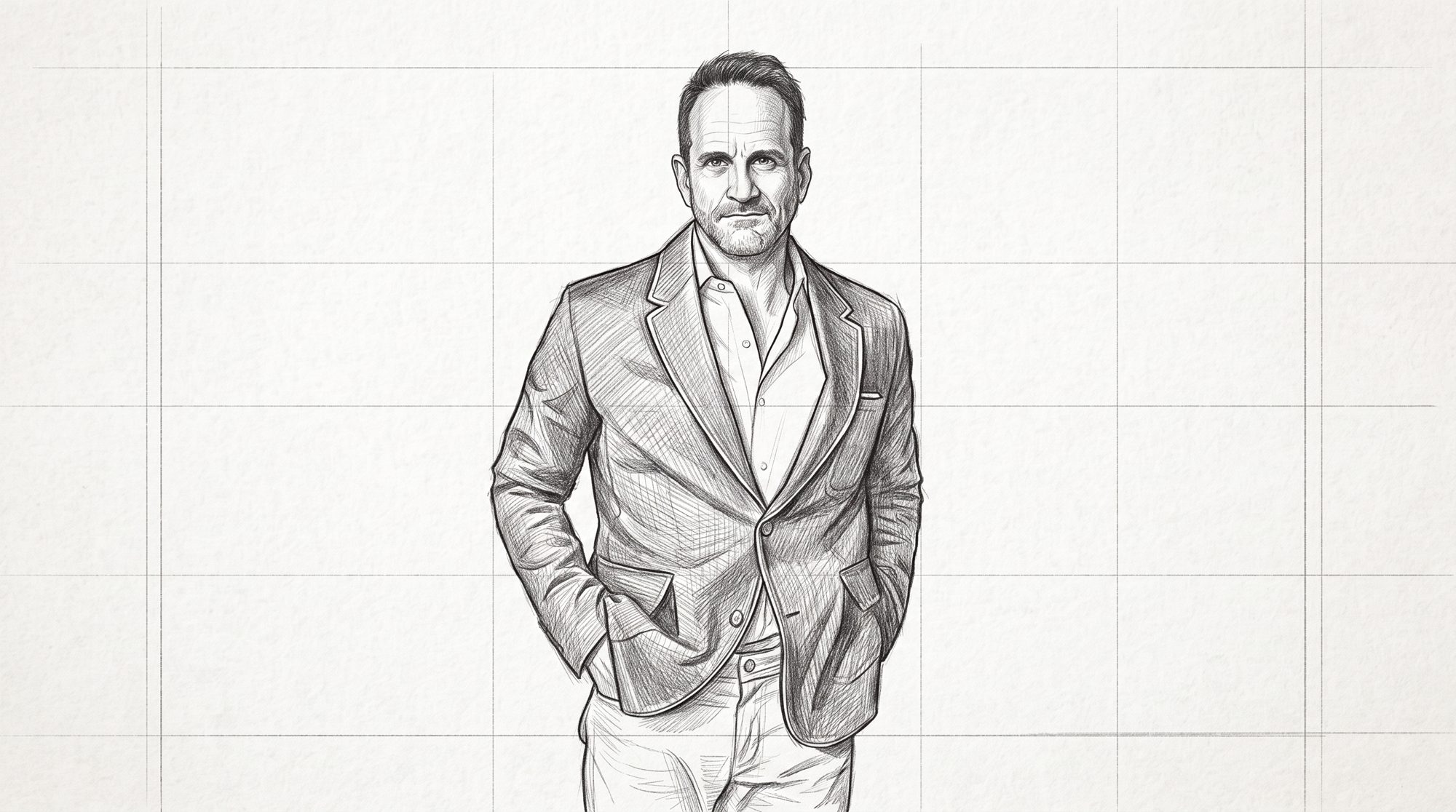
Pencil sketch of Joe on drafting paper

What happens next

Drawn before
it's shot.

Nothing gets improvised with Joe on set. Every frame is drawn, timed to temp music, and approved before anyone rolls, so he walks in knowing exactly what happens. Locations come first because the space decides the pictures, and the scripts go to the Bar with nothing in them a location could break.

Sept 4Direction and investment reviewed with Mckenzie
~Sept 20Scripts to the Florida Bar. Joe reads both aloud first.
OctoberLocations locked. Storyboards and previs cut delivered for Joe's sign-off while he's still in trial.
Nov 6 · 13 · 20Shoot weekends held. Two days with Joe.

Pencil study

Lensea FilmZarzaur Law · 2026 Commercial Campaign Treatment
Sound off · scores fade in over each script